

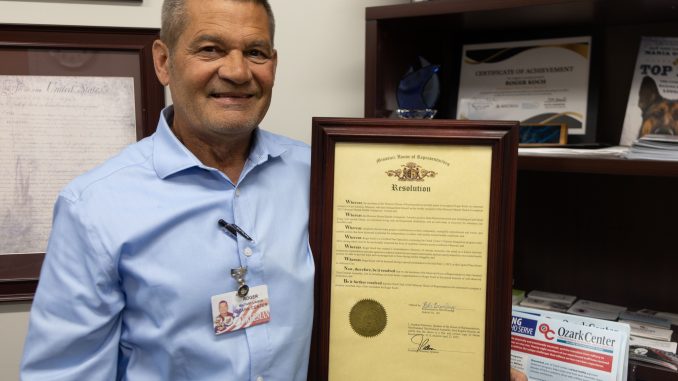

(Joplin, MO) – Roger Koch, the man who’s helped scores of Joplin area veterans mentally transition back into society following military service or deployments overseas, received unexpected recognition for his selfless work earlier this month.
The U.S. Army veteran, who oversees Ozark Center’s Veteran Integration Program (VIP), was named a 2025 Mental Health Champion by the Missouri Mental Health Foundation.
Koch was one of three winners chosen from a pool of nearly 50 quality nominees.
“I consider it to be a great honor,” Koch said, who attended the Foundation’s banquet in Jefferson City on May 1. “It’s something that you never think will happen and not something you actively pursue, but when it does happen it makes you feel very grateful.”
Missouri Mental Health Champions are individuals who make positive contributions to their community, and whose actions have increased independence in others with similar mental health conditions.
Koch, of course, was recognized for his groundbreaking, one-on-one work with military veterans struggling with mental health issues, primarily post-traumatic stress disorder (PTSD). It’s a subject Koch is all too familiar with. Serving in the U.S. Army from 1985 to 2005 – including an 18-month combat deployment to Baghdad during Operation Iraqi Freedom — he returned home with PTSD symptoms.
“Experiencing life-changing events right before my eyes affected me,” Koch admitted. After retiring from the military in 2005, “I chose to do what most combat veterans do, and that’s to bottle everything up and cope with things the best way I knew. By doing so, I found that my way of dealing with my personal trauma led me to unhealthy and negative coping skills.”
He struggled with virtually every aspect of life— from fitting into society to finding a meaningful and enjoyable job, he said. In fact, Koch kept his PTSD struggles bottled up inside for 14 years before his wife, Jen, suggested he seek professional treatment.
“I must admit, asking for help was a huge first step for me,” Koch said. “You figure, throughout my military career, it had been overly emphasized that a veteran should never ask for help or need assistance; it was considered a weakness if you did. Once I finally let my guard down and talked openly to mental health professionals, it didn’t take them very long to diagnose me with anxiety, anger issues, depression, and PTSD.”
It was around this time, ironically, that Koch first learned of Ozark Center’s search for a local veteran to lead its groundbreaking VIP program.
“The basic job description would be working with other veterans and their mental struggles. This position proved to be life changing for me,” he said. “It gave me the opportunity to work and help other veterans that might be struggling — just as I was.”
Tragically, a Veterans Affairs study showed that an average of 22 veterans commit suicide each day. Hoping to reverse that trend, one veteran at a time, “has definitely given me a purpose in life,” Koch said.
As the old saying goes, Koch was the perfect person for the job. Due to his veteran status, and because he’s familiar with PTSD’s destructive and disruptive power, he discovered it was easy to connect with the veterans he counseled, themselves wary about opening up to non-military veterans about their internal demons.
“Being a veteran seems to make the conversations more open,” Koch said. “I’m not sure if it’s because of the ‘trusting another veteran’ thing or being able to speak and understand the military jargon. Nonetheless, veterans tend to open up easier to other veterans.
“And no, my experiences and trauma might not be exactly like theirs, but it’s amazing to see and hear how relieved they are to know that I understand what they’re going through and can relate to their struggles,” he continued. “Probably the main thing that I always want fellow veterans to know is that they are not alone and that someone is there to listen.”
Koch praises both Ozark Center and Freeman Health System for recognizing the plight of military veterans when they established the VIP program in 2018. It was their insight and proactive thinking that enabled the VIP program to become a pillar and model for other state and local programs to learn and build upon.
“Though veteran mental illness might seem overwhelming to some, I think one of the most important things that society should know and understand is that veterans are ordinary people with extraordinary experiences.
“For anyone struggling with mental illness, I think that the most impactful and encouraging words that I can share would be to, first, ask for help and then accept the help,” he continued. “It’s never too late to ask for help. Seeking help does not mean a person is weak. In fact, I think by asking for help it indicates strength.”
About Freeman Health System
Locally owned, not-for-profit and nationally recognized, Freeman Health System includes Freeman Hospital West, Freeman Hospital East, Freeman Neosho Hospital and Ozark Center – the area’s largest provider of behavioral health services – as well as two urgent care clinics, dozens of physician clinics and a variety of specialty services. In 2024, Freeman earned dozens of individual awards for medical excellence and patient safety from CareChex®, a quality rating system that helps consumers evaluate healthcare providers and their experiences. U.S. News & World Report named Freeman Health System one of the Best Hospitals for 2022. With more than 320 physicians on staff representing more than 90 specialties, Freeman provides cancer care, heart care, neurology and neurosurgery, orthopaedics, children’s services, women’s services, and many others for all of the Four State Area. Freeman is also involved in numerous community-based activities and sponsored events and celebrations. Additionally, in the Joplin/Pittsburg areas, Freeman is the only Children’s Miracle Network Hospital in a 70-mile radius.
About Ozark Center
An integral component of Freeman Health System based in Joplin, Mo., Ozark Center provides comprehensive behavioral health services to children, adults and families in an area that includes more than 450,000 residents from Missouri, Arkansas, Oklahoma, and Kansas. Ozark Center continually looks for innovative ways to address the mental health needs of the community and promote awareness of mental illness in an effort to eliminate the discrimination associated with it. For more information, visit ozarkcenter.com or call 417.347.7600.
Reference:
Ozark Center
Freeman Health System
417.347.7600


Be the first to comment